As I sit here in my small apartment in Prague, penning these thoughts in my diary, I can’t help but reflect on the chaos that once defined our family life. It all began with those endless arguments that echoed through the stairwell of our panel building. “What’s the matter with you this time?! How long can this go on?! I’ve had enough of it all!” My mother’s voice carried from behind the door, audible throughout the entire entrance.
At that moment, my brother Matěj and I were ascending the stairs. We stopped dead in our tracks, as though we had bumped into an invisible barrier. For a brief instant, our gazes locked, and in that fleeting connection, words were unnecessary. We understood each other perfectly without a sound: it was best to leave now. Sighing simultaneously, we turned and quietly made our way away from the building. Returning to the apartment that evening was clearly not in our plans.
Who in their right mind would choose to spend the evening listening to perpetual parental quarrels? Definitely not us! We marched determinedly toward the neighboring entrance where our grandmother, Ludmila, lived. Her place had become our refuge in recent times. Whereas before we only visited on weekends, now we sought shelter there nearly every night.
The atmosphere at home had become utterly intolerable. Our parents shouted at each other nonstop, seemingly oblivious to everything else. What was worse, they increasingly tried to pull us into their fights.
Sometimes, mother would turn sharply to me and demand, “Tell me, am I right? You agree with me, don’t you?”
Other times, father would address Matěj without waiting, “No, I’m right in this! Back me up!”
We remained silent. We had no desire to pick sides or become entangled in their never-ending conflict. All we wanted was quiet, calm, and warmth things we always found at grandma’s.
These scenes played out daily, like a scratched record that no one dared to lift the needle from. We had learned to spot the early warning signs: a certain tone, abrupt movements, the way they exchanged looks. These were cues that it was time to escape. What child enjoys living in constant stress, where any conversation can explode into a loud fight at any moment?
We struggled to understand what had sparked this family disaster. Our family was never picture-perfect like in advertisements, but once upon a time, our parents could resolve disagreements. Arguments happened that’s normal but they ended with calm talks rather than yelling. Mother might frown, father might raise his voice a bit, but within half an hour, it was settled. We’d gather at the table for tea and plan the weekend.
Then, about two years ago, everything shifted. It was as if our old parents had been replaced by strangers who argued over the smallest things. A dirty mug left on the table? A long lecture on carelessness and disrespect. A shirt on the wrong hook? Sarcastic comments about household order. A spoon left in the sink? Treated like a major offense warranting endless discussion!
One evening, as I sat in grandma’s kitchen stirring my tea absentmindedly, watching the amber swirls, I asked with bitterness, “How did it come to this, grandma? Everything changed after their vacation together. What happened there?”
Babička Ludmila paused, set down her cup, and gently touched my hand. She too only guessed at the causes of the discord, and those guesses brought her no joy.
“The adults will work it out,” she replied softly, her voice steady. “Sometimes people need time to figure out the best path forward.”
I nodded, though skepticism showed in my eyes. I knew she was holding back, but I didn’t push. What was the use? They still saw me as a child, so serious matters stayed off-limits.
“We can’t stand these fights anymore!” Matěj burst out desperately. “We can’t focus on homework or read in peace! I can’t even recall the last time we ate together as a family. If being together is so hard for them, they should divorce it would be easier for all of us!”
The words poured out, capturing the reality of recent months. Matěj spoke for both of us; he knew I shared the feeling. Silence had vanished from our home: mother would snap, father would retort irritably, and the bickering would resume with no escape.
“Matěj…” grandma hesitated, setting aside her knitting to look at him intently, slowly shaking her head. “Have you considered what happens if they divorce? You two would be split up. Are you prepared to live apart from Jitka?”
“We’ll live with you!” I said right away, my eyes pleading. “We’re here most of the time anyway! You wouldn’t mind, would you?”
Babička Ludmila hesitated. She understood our exhaustion from the constant arguments. On one hand, we’d be safe and cared for in her calm home, able to study and relax without interruptions. She loved us dearly and would provide that security.
On the other hand, there were our parents to consider. How would we explain our desire to leave? Would they accept it? And if so, how might it affect our bonds with them? Could this lead to a complete rift?
“Let’s not rush into anything,” she sighed deeply. “I love having you here, you know that. But first, let’s talk to your mom and dad. Together, we might find a way to mend things.”
“Don’t worry, we’ll handle the talk,” I said confidently, smiling. Grandma was nearly on board, which mattered most. “Just don’t turn us away! We can’t stay there any longer! It would be better for them to separate otherwise, they might actually harm each other one day! I saw dad almost hit mom yesterday… He didn’t, really! But he was close.”
I stopped, recalling the frightening scene. I had gone for water and stood frozen: father with his hand raised, mother ducking instinctively. That moment felt endless.
“Grandma, please agree!” Matěj urged, taking her hand. “We’ll help with everything around the house. Just don’t make us go back. They ignore us completely! Yesterday, I told dad about the parent-teacher meeting. He said, ‘Ask mom!’ So I did. Guess what she said?”
“Go ask dad?” Babička Ludmila guessed softly.
“Yes!” Matěj laughed bitterly. “Then they argued for two hours about who should attend, yelling from separate rooms. I just stood there listening.”
“And when I asked them to sign a form for a museum trip,” I added, eyes down, fingers twisting my sleeve, “I’m the only one in class who can’t go because neither signed. Instead, they fought over whose responsibility it was.”
Babička Ludmila saw the deep fatigue in us not ordinary tiredness, but the kind built up over months of tension replacing warmth, indifference replacing support.
“It’s always this way,” Matěj sighed wearily. “Every request from us sparks a new fight. We dread going home. The other night we arrived late, and instead of scolding, they just sent us to bed without asking where we’d been. Later, they blamed each other for bad parenting.”
We sighed together. Lately, we’d been thinking divorce might be the only solution, but the idea of being separated terrified us. One with mom, one with dad our closeness reduced to occasional visits.
We’d whisper plans in our room at night. Matěj once joked about running away with backpacks. He smiled to lighten the mood, but I took it seriously: “What if we did leave, even for a few days?” In that instant, we realized how bad things were that escape seemed reasonable.
Then it hit us: grandma! Why not ask to move in with her? The idea came to both at once. I spoke first: “Let’s ask grandma to let us live here? She won’t yell or argue, and we won’t hear those fights…” Matěj added, “Yes! She’s kind and supportive. Her apartment is big enough.”
We imagined peaceful mornings, quiet study time, board games in the evenings. No more hiding from arguments. Hope returned for the first time in ages. Let the parents handle their issues; we’d find peace with grandma…
The day came when we faced our parents.
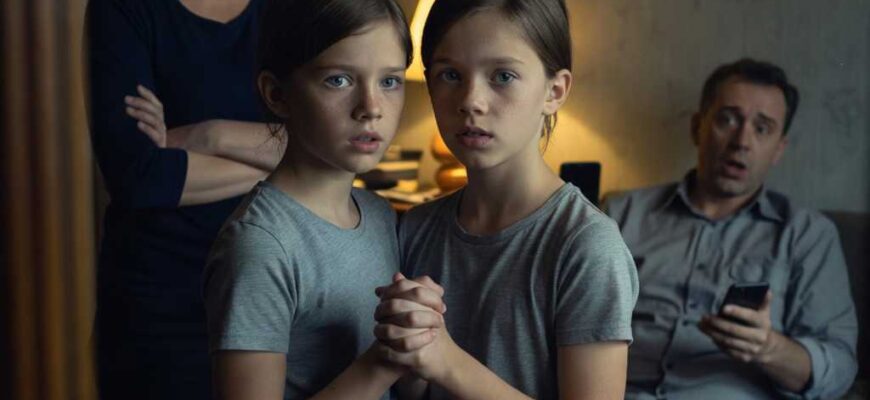
“Mom, dad, we need to talk seriously,” we said firmly in the living room that evening. I gripped Matěj’s hand for courage. “But promise to hear us out first.”
Michal looked up from his phone, surprised. Aneta straightened from arranging things on the couch, her face showing disbelief.
“This is your doing!” she huffed, arms crossed. “The kids are dictating terms now, like we owe them explanations!”
“Look who’s talking!” Michal snapped, setting his phone aside. “I’m always working to support us. You were home with them! What did you teach them? Now they’re in charge?”
We exchanged glances. This was the usual blame game starting, but we pressed on.
“Stop!” I exclaimed, voice shaking but determined. “We’ve decided you should get a divorce.”
Silence fell. Aneta’s mouth hung open; Michal stood up slowly.
“That’s news!” she said threateningly. “Jitka, you’re too young to advise us on life! And what else have you decided? Maybe split our apartment too?”
“If you don’t divorce, we’ll contact child protection services,” Matěj said, squeezing my hand for strength. “Dad, you could lose your job. Your company hates scandals, right? You said reputation is key.”
“And you, mom,” I continued, meeting her eyes, “neighbors will lose respect for you. No one will talk to you once we share details about the fights!”
“They’re threatening us! Look at them!” Aneta cried, glancing between us. “Our own children! How could you?”
“We’re not threatening,” Matěj said steadily. “We just can’t live like this. We’re exhausted from the yelling, from being ignored, from requests turning into fights.”
“You’ll divorce and move out, and we’ll live with grandma,” we said together. “It’s better for everyone peace for us, no conflicts for you. We won’t be caught in the middle anymore.”
The parents were stunned into silence. Usually they’d argue immediately, but now they had no words. Our behavior was unexpected for thirteen-year-olds, speaking of such adult matters.
They had considered divorce before but worried about splitting us twins. We were inseparable, always together. The grandma idea hadn’t crossed their minds amid their own issues, but now it seemed possible. Grandma loved us, her apartment was roomy, she was welcoming.
“I’ll call my mother,” Michal muttered. “If she agrees…”
Aneta cut in, her voice heavy with exhaustion: “Then we’ll stop torturing each other. Call her. I’ll be glad not to see your face daily.”
The words hung there. She hadn’t meant to be so blunt, but years of hurt forced them out.
“And I’ll be thrilled!” Michal replied with bitter irony masking his pain.
No anger, just sadness at how things had soured. He dialed slowly as they avoided each other’s eyes, sensing a point of no return.
That day, we Kovářs made a big decision. It started with Michal’s long talk with Babička Ludmila. She listened quietly, asking questions now and then.
After he finished, she sighed: “If you both agree it’s best for the kids, I’ll take them. They’ll be safe here.”
By evening, Michal and Aneta talked calmly in the kitchen for once. They decided divorce was the answer. We’d move to grandma’s, and they’d send money monthly for us.
They promised to visit on weekends, but different days to avoid each other.
“I’ll come Saturdays for outings, you Sundays,” Michal said, and Aneta nodded. “So the kids don’t feel abandoned.”
They vowed not to badmouth each other around us or argue in front of us.
“We’re still parents,” Michal noted. “Even if not married.”
It worked. We relaxed and lived normally. I joined an art club I’d always wanted. Matěj played football and made friends. We explored the city, saw movies, talked freely without fear of fights.
School improved too with the quiet. No distractions, better grades. Teachers praised us.
Life became steady, not perfect but peaceful. We stopped hiding, living as teens should with support…
Five years on, things were routine. We were used to it: school, activities, friends, evenings with babička. Parents visited alternately with gifts, communicating politely now.
They met at our graduation. At first wary in different seats, but during dancing, Michal asked Aneta to dance, reminiscing.
After, they talked in the yard about us and old times, behaving well, focusing on good memories. We watched, happy yet sad they had been enemies.
Then, next day, they called us to a café. Over tea, they held hands and announced remarrying, saying feelings remained.
We were shocked, faces darkening. Again the same mistakes? Could it work without fights?
“Really?” I asked.
“Yes,” Michal said. “We’ve changed, learned to listen. Second chance.”
We said nothing, not wanting to discourage but unable to fake joy. Parents were hurt by our silence.
Conversation stalled. On the way home, I told Matěj I hoped they knew what they were doing. He sighed.
“So, off to Prague?” I asked, opening my laptop for university sites. “Away from this craziness. I see how this circus ends!”
“Yes,” Matěj said tiredly. “They’ll be fine for a month or two, then back to yells and blame. I won’t be their hostage anymore, wondering their mood each morning.”
He paced, collecting books. “Why do grown-ups act like unstable teens? Always repeating mistakes instead of fixing things?”
“We have to leave,” he said at the window as dusk fell. “Far enough their fights can’t touch us. They can deal with it. We’re not their therapists or shields. We have our dreams; I won’t let this ruin them.”
“When do we apply?” I asked.
“Tomorrow,” he said firmly.
I nodded, scrolling Prague uni pages, listing pros, cons, deadlines in my notebook.
“Main thing is calm studies, no distractions from their issues,” I said. “Good we’re far.”
“Yes,” he agreed. “We won’t hear the blame games. Their ‘second chance’ is their business.”
They did remarry, modestly at city hall with close family and dinner, no big party.
Photos showed them happy, holding hands. We wondered if it was different this time.
But no. Peace lasted weeks, then nitpicking returned. After a month, arguments over small things. After two, it exploded: Michal threw a cup, Aneta a plate.
Then they’d call us crying with complaints.
We learned to cut calls short: “Mom, in class, later.” “Dad, busy, weekend.”
Calls dwindled as we focused on our lives.
I studied psychology, volunteered helping troubled teens, seeing my past in them, giving support I missed.
Matěj loved IT, programming, hackathons. His team placed in a contest, he worked part-time.
We planned futures: my practice for families, his business. Over tea, we felt independent.
When parents tried pulling us in again, we stood firm: “Sort it yourselves. You have your life, we have ours.”
“But you’re our kids!” Aneta cried.
“If you acted like adults, we’d support you,” Matěj said. “You erred remarrying and keep hurting each other. Divorce and separate.”
It might seem harsh, but we just wanted peace.